

By Neil Lurssen
When my wife Jean and I rented an isolated beach cottage for a long weekend getaway, our two black Labrador Retrievers – Jack and Nova – came along too. When I say isolated, I mean like finding yourself alone in a dungeon under the Tower of London, guest of Henry VIII. There was nobody else there on the miles-long beach. Just the two of us and the pooches. The first night was as dark as I have ever seen; no moon and high clouds hiding the stars. You needed a GPS to see where your hands were. About midnight I took the dogs outside for their go-to-bed pee – and realized immediately that I had made four big mistakes: (1) the dogs were off-leash, (2) their battery-powered collar lights were not attached, (3) I did not have a flashlight, and (4) Jean was sleeping. She usually solves everything that bugs me but now I had to deal with this problem myself.

The problem: Jack and Nova disappeared into the dunes behind the cottage and my recall whistling efforts were laughably pathetic against the distant crashing of the waves. Lots of time passed and I could hear and see nothing of my black dogs on this black night. I wanted to go to bed but I could not leave them out there. Were there hungry predators in the dunes? Venomous snakes? Were they wandering around in a panic? Running further and further away? Going inside to sleep was impossible – so I found a deck chair, wrapped myself in a blanket against the night chill and resolved to stay alert until the return of my two buddies.
I was awakened about an hour later by pressure on my legs. It was plump Nova, snuggling into her share of the blanket. To my relief I recognized Jack’s signature snore nearby. When Jack slept everyone could hear exactly where he was. Where had they been in the blackness? How had they found their way around the dunes before returning to the cottage? Clearly they could see me when I could not see them. So – intrigued – I looked into the matter when we got home.
It turns out that quite a lot of research has been done and that dogs can indeed see very well in the dark, much better than we humans can. They can thank evolution and Darwin’s survival of the fittest for that. As we all know, our beloved pets are descended from wolf-like predators. That’s how they all got those four impressive canine fangs in their mouths – even our tiniest fluff ball chihuahuas among them – though they no longer need killer teeth with Alpo and Arcana putting up no resistance at dinner time. But, getting back to eyesight issues, their distant ancestors were crepuscular hunters which means they did most of their stalking in dim light at dusk and dawn. The process of natural selection adapted their eyes to see shapes and movement in the gloom. Obviously other senses like smell and hearing were also sharpened down the millennia for successful predation, but that’s another story; it is eyesight we are looking at here.

Today’s dogs have retained that ability to see in the dark. Whether or not it is as acute as it was in pre-historic times we cannot know, but our dogs certainly have some of it now. Scientists discern that by examining the dissected canine eye. Dogs, they have found, have many light-sensitive cells or photoreceptors in the retinas at the back of their eyes, far more than we do. These cells are called rods and they boost night vision. Human eyes, on the other hand, have retinas dominated by cells called cones that are far more effective in making out colors. So if you take your dogs out for a walk on a dark night, they will see their surroundings much better than you can. But they won’t notice that your jacket is scarlet.
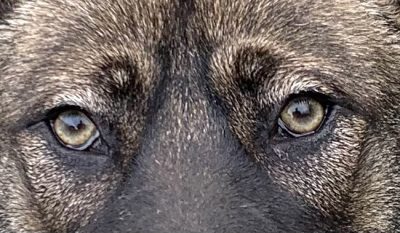
Fido has more than just his rods to help him in the dark. He also has his tapedum lucidum – a layer of cells behind the retina that reflect light and give his night vision a big extra oomph. When you shine a flashlight at an animal at night, when your car’s headlights pick out a deer in the road, their eyes glow because of the tapedum reflection. If you like to walk your little dog after sunset, be sure to take your flashlight along and aim it at dark places; those bright eyes shining at you from a distance could be coyotes that have been known to prey on the small guys. But they could also be harmless raccoons.
I have had the privilege of seeing night shining eyes in conditions of Africa’s deepest nature – once when crocodile eyes dotted the surface of a moonlit lake; another time when a leopard stood his ground on a high mountain pass and stared back at us. In both instances, their glowing eyes were orangy-red but dogs’ eyes can reflect in a range of colors from green or blue to orange or yellow. Humans don’t have that tapedum reflective layer. We are shine-less in the dark.
Dogs have other night vision advantages – one being that their pupils are larger than ours which means that more light is admitted. So when your much-loved pal fixes his big brownies on you (or his big blueys in the case of your Husky or Aussie) he is getting a brighter look at you than you are getting at him. However, you have an advantage over him when it comes to color. The researchers have found that canine color blindness is a myth and dogs can indeed see some colors – but only yellows and blues. Other colors like greens and reds appear to them in shades of grey because they are not as sensitive as we are to the full spectrum of the ultra-violet wavelength.
Now that we know this, it has been suggested that blue and yellow be used more often in selecting toys and training aids, just to make these objects more recognizable to our best friends. For instance when you throw a ball or a frisbee in a fetch game, it is likely that yellow or blue ones will be easier to see than a red one that will look grey against grey grass. So let’s hope that tennis ball makers will continue to produce them in those familiar bright yellows.
There is yet another factor that scientists are researching in canine vision – a tongue-twister condition known as Flicker-Fusion Frequency or the easier to say FFF.
This is the rate at which flickering images can be seen as solid images. When we watch shows on our TV sets, the images seem to be solid but they are actually flickering at a rate that we cannot see.
 However, dogs – say the scientists – can see the flicker and this makes it easier for them to see slight movement of objects and other animals in dim light. An asset for hunters in other words.
A parting thought: My dogs use their toys for tug o’ war games with each other whatever their color.


